Available at Amazon!


Paperback: $28.95 at Amazon
Epubs also available for: $14.99 at:

Pair the book with:

Knight Island stands out in Prince William Sound for its bold volcanic terrain and uplifted geology. Its intricate, meandering shoreline, cut with multi-armed bays, secluded coves, and island passages offers some of the Sound’s most rewarding wilderness scenery.
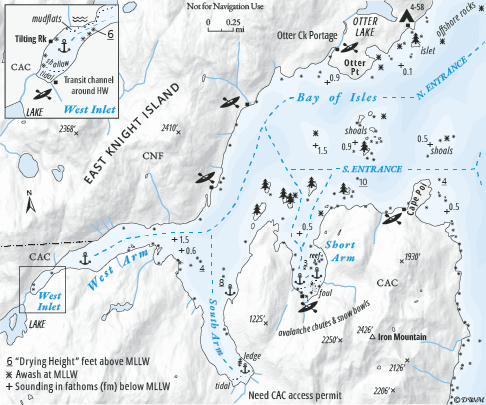
Bay of Isles is the largest embayment on Knight Island's weathered east shore. The spacious indention is known for its scenic, but intimidating collection of islands, islets, rocks, and shoals, scattered throughout the bay. The bay is well-charted by NOAA and, with careful navigation, hazards can be avoided. Each arm of Bay of Isles has suitable anchoring options, although each also is subject to williwaws during heavy gulf weather. The Chugach Alaska Corporation owns lands along the southern part of the bay (See map). Campers without a CAC use permit can camp at the CNF site (4-58).
Excerpt from "Exploring Alaska's Western Prince William Sound":
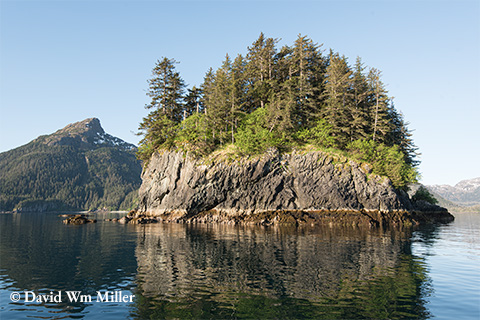
Kayaking and Camping: 4-58. Bay of Isles N. "A prominent, wooded islet stands out at the bay’s outer N entrance, 0.75 mi NE of Otter Point. A conspicuous S-facing pocket beach, on National Forest land, rests immediately N of the wooded islet. This beach area affords several camping options, including open spaces safe from spring tides. A slow-moving, tannin-stained stream and a pond hide behind the durable berm. Several wildlife trails aid access to the uplands and to a neighboring beach. Otter Lake (100’ elevation) sits on the hillside several hundred yards above the base camp. This beach is among the most hospitable campsites on the east side of Knight Island, although beach landings are weather-dependent."
Short Arm, Bay of Isles: "For first time visitors, close attention to navigation is necessary for exploring Short Arm, but it’s worth it for the raw, rugged scenery found inside. When approaching the arm, a notable 0.5 fm deep shoal lurks mid-channel in the bay’s outer entrance (See map). Pass on either side of the shoal area. Midway into the arm, favor the W shore to skirt rocks from an extensive reef reaching more than halfway across the arm from the E shore. Offshore rocks and shoals foul the head. Snow-capped mountain peaks and a deeply cut avalanche chute dominate the arm’s towering headwall. Beneath the chute, a rocky debris field, covered by higher tides, fills the bay's entire SE corner. A steep, inhospitable waterfront surrounds the cove, except in the lower W corner, where a low berm beach gives easy access to the shore. Remnants of a wooden-hull shipwreck and a scattering of driftwood logs rest on the beach."
Short Arm Anchorage: "Anchor along the W portion of the lower arm in 7-9 fms, or anchor in 6 fms off the E shore, between the reef and avalanche debris field, on a mud bottom."
West Arm, Bay of Isles:
"Enter the West Arm by slightly favoring the N shore to skirt a 1.5 fms deep shoal at the arm’s entrance, then return to mid-channel. The shoreline is sloped and wooded, with several melt water streams descending the hillside, especially along the N shore. Cobble and boulder intertidal beaches provide rocky but suitable landing options. About 1 mi inside the entrance, the bottom begins to gradually shallow, and the shoreline tapers to a short bottleneck channel at the entrance to West Inlet."
West Arm Anchorage:
"Anchor in 4-7 fms in the arm's middle, 0.25 mi from the entrance to West Inlet. A typical summer afternoon sea breeze sweeps in from the arm’s entrance, helping to keep the bugs down."
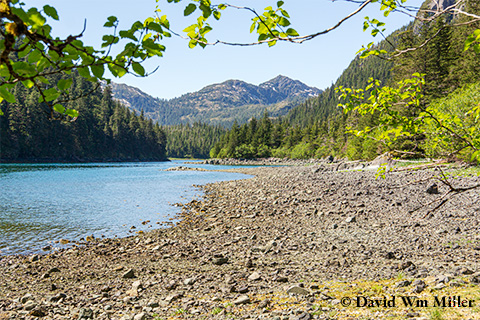
West Inlet: "The West Inlet's bottleneck entrance channel shallows to less than 1 fm, so time your transit during higher tidal stages. Several nearshore rocks uncover along the channel’s S shore. The most notable is a large triangular boulder, with a drying height of 6 ft, surfaces one-third of the way into the channel. A thin, cobble ledge runs along the channel’s N shore. Transit the channel slightly N of mid-channel to easily skirt the hazards. As the inlet’s passage opens, move to the middle to avoid the tidal flats extending off the N shore. The inlet’s gently-sloped, bottom has a maximum depth of 4 fms in the middle.
West Inlet Anchorage "Drop anchor, 3-4 fms, across from the eye-catching tilting rock on the N shore. A handful of nearshore rocks and tidal flats uncover toward the head."
Learn more details about boating, kayaking, beach combing, and camping options on Knight Island and the western Sound by ordering Exploring Alaska's Western Prince William Sound, in paperback or Epub, at Amazon, Google Play or at Apple Books.
